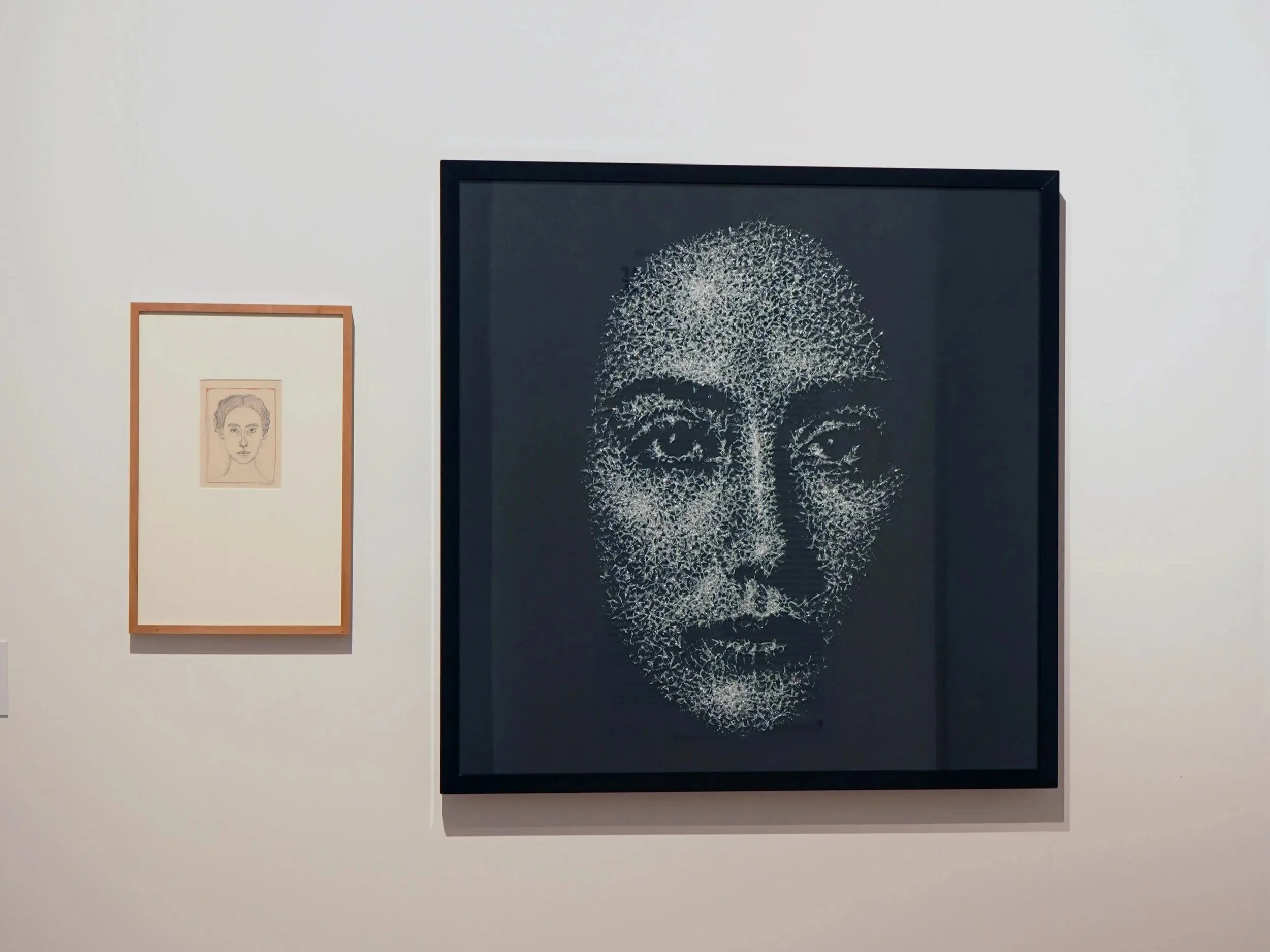
Simon Berger’s reinterpretation of Ferdinand Hodlers portrait study of Valentina Godé-Darel from 1909.
Berger's starting point is the extensive body of studies and sketches held by the National Gallery of Bosnia and Herzegovina — fleeting sheets, preparatory drawings, unfinished faces. From these he makes no copies, but portraits of his own in glass: he imagines how the figures Hodler only outlined might have looked on canvas, and carries their line forward across a century.
At the centre is the human face. Hodler's studies capture faces whose contours have faded over time — on paper as much as in people's memory. Berger gives them their outline back. In a gallery of portraits, the faces appear in different formats, from intimately small to larger than life, so that the sheer presence of a face becomes the real subject. What was in danger of vanishing on Hodler's sheets gains a new, tangible presence on the translucent glass — a gaze that returns from the broken light and looks back at the viewer.
None of this would be possible without a singular ability. Glass forgives nothing: a strike cannot be corrected, softened or painted over. Before the first blow, the finished portrait must therefore already stand before Berger's inner eye — not as a flat picture, but as a three-dimensional body of light, for he must anticipate how each fracture will travel through the depth of the pane and how the light will break along it. What Hodler pursued on paper — approaching a face through study after study until its essential lines emerged — Berger performs inwardly: the searching, weighing and discarding that fills Hodler's sketchbooks is compressed into pure concentration, into the moment before the hammer falls.
Seen this way, the two practices mirror each other across the century. Hodler's studies are thinking made visible, preserved sheet by sheet; Berger's portraits are thinking that must remain invisible until, in a single unrepeatable pass, it becomes permanent. The drawings in Sarajevo thus meet an art that begins where drawing ends — with the image already complete in the mind, waiting to be released from the glass.
Berger extends this presence into space as well. In rhythmically hung panels and staggered panes of glass, he takes up central motifs of Hodler's — the face of his wife Berthe, the Youth Admired by Women (today at the Kunsthaus Zürich), the Lumberjack — and lets them take shape piece by piece. Hodler's own theory of "Parallelism" resonates here, repetition as a pictorial force: the image does not appear at a single glance but emerges gradually from the surface. That it is the Lumberjack of all motifs that recurs — that emblem of strength and labour — holds particular meaning for Berger, a trained carpenter.
"The Persistence of Presence" names what holds this dialogue together across the decades: the endurance of a presence over time, from paper to glass, from one generation of artists to the next.
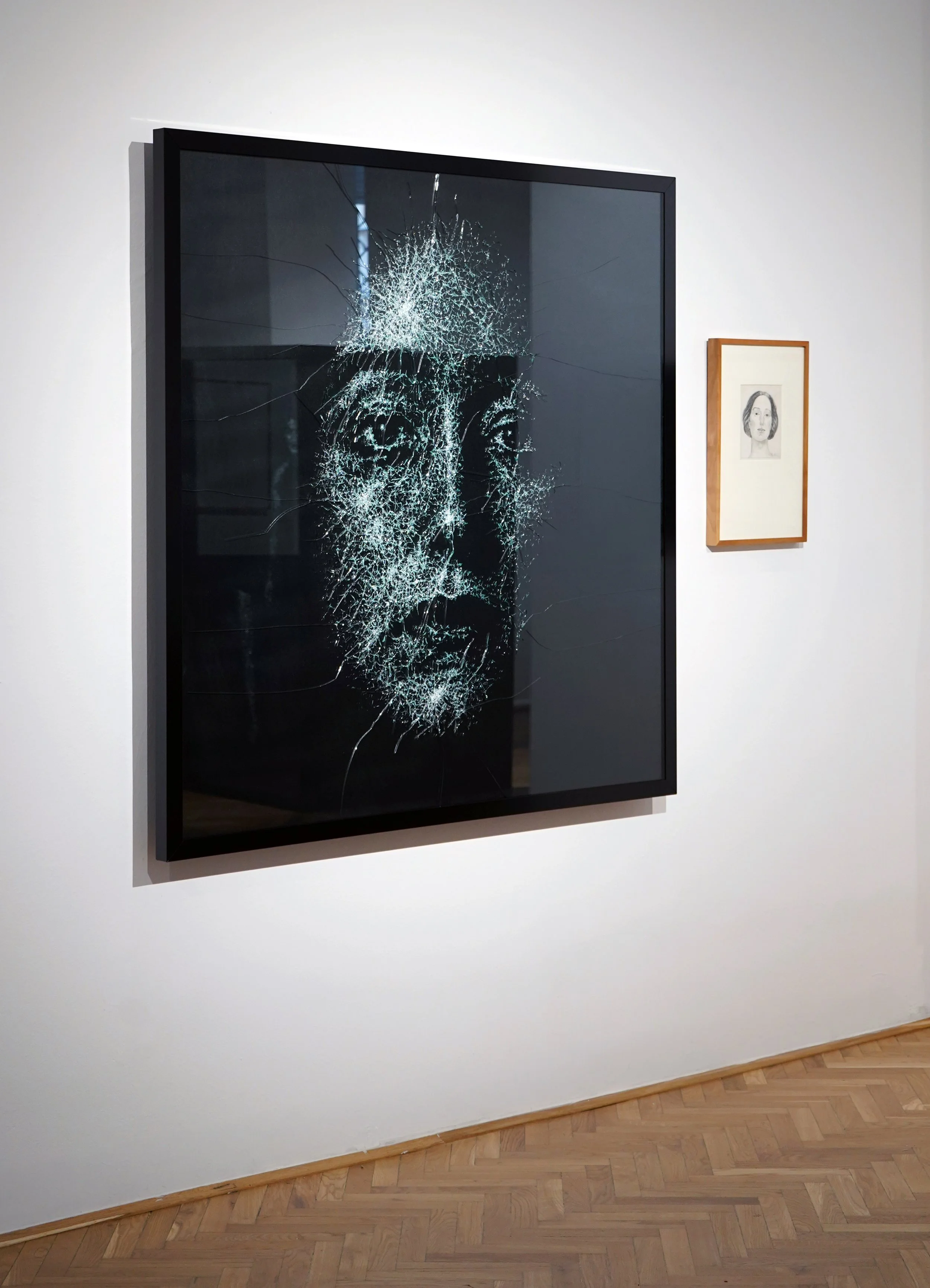
Simon Berger’s reinterpretation of Ferdinand Hodler’s portrait study of Jeanne Charles from 1910.