Tobias Gutmann & Sai bot — The Hand and its twin
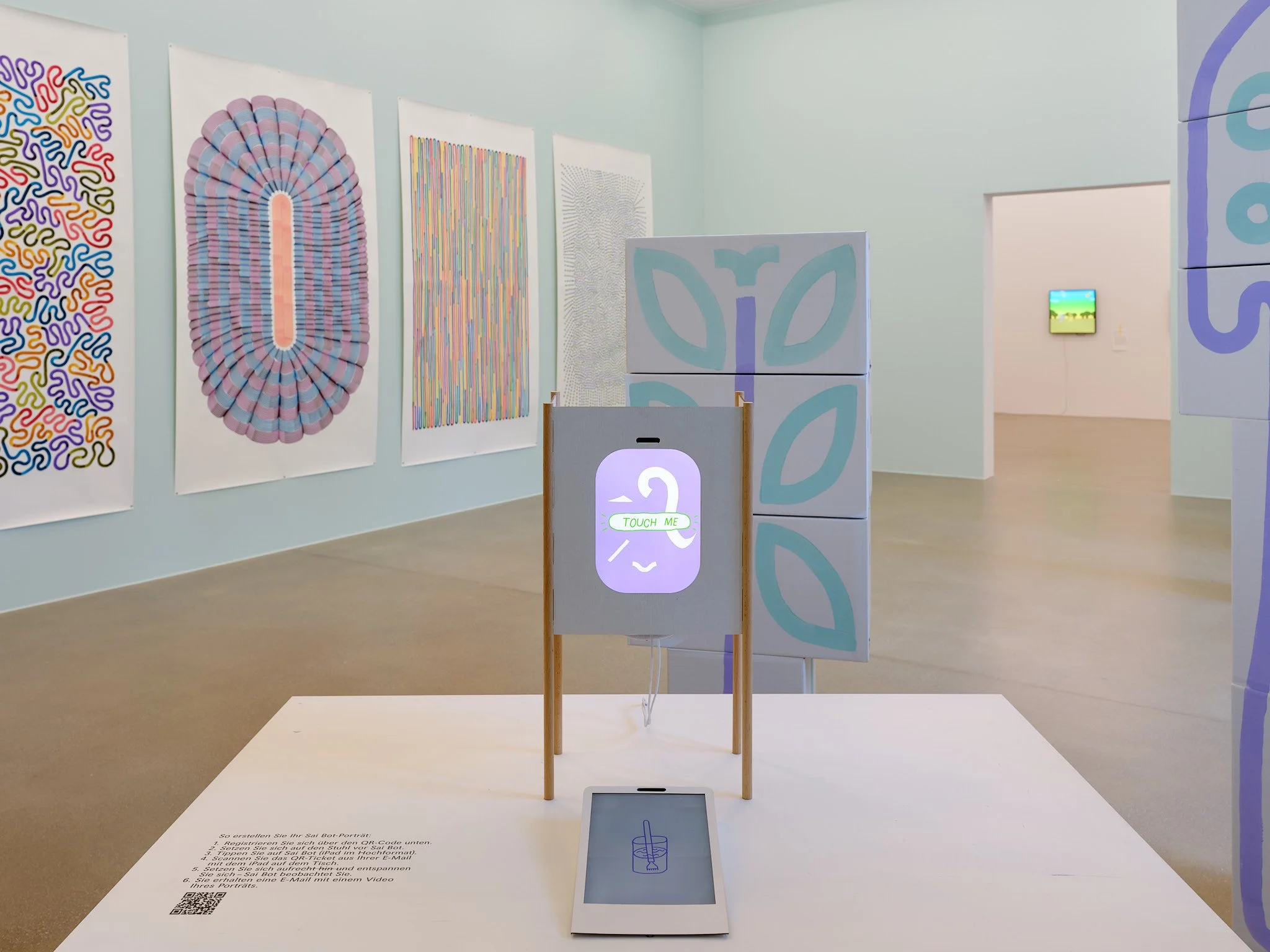
Tobias Gutmann and Sai Bot in «Artificial Creativity» at Aargauer Kunsthaus, Aarau.
Whoever sits down in front of Sai Bot faces a figure made of cardboard that speaks with the voice of its inventor. «Look straight ahead and relax your shoulders,» it says. Behind a small screen, face recognition locates eyes, nose and mouth, a separate module reads the length, structure and colour of the hair. What the machine sees is matched against thousands of hand-drawn portraits and translated into the vocabulary of one artist. On a second tablet the sitter watches the face appear, line by line.
Computationally this would take seconds. Sai Bot nevertheless takes five to seven minutes, the time its inventor needs for a portrait of usually five to seven strokes. The waiting is part of the work. The bot chats and sings, asks whether it may change the colour of the lips, and the voice is that of Tobias Gutmann, who recorded more than 1,000 sentences from which the bot now forms phrases of its own. The encounter feels real, although the artist is not in the room.
Read «Tobias» backwards and you get «Sai Bot», with the word bot already inside it. Since 2019 this draughtsman has had a twin, developed with the studio Dazlus (Zurich/London). At Aargauer Kunsthaus the work stands for a question art is having to renegotiate right now: who owns a hand, once a machine has learned it?
From photo booth to encounter
The hand belongs to Tobias Gutmann, born 1987, and it has been drawing strangers since 2012. It began in Stockholm. Gutmann, a student and new to the city, was looking for a way to come into contact with people he did not know. He built the Face-o-mat, an abstracted, analogue version of a passport photo booth: a box with a window, the artist inside, the sitter outside. He looks at the person opposite through the frame and draws them in front of an audience, in a few minutes, with a few strokes. No photograph, no screen, just a hand and a sheet of paper that the sitter takes away.
The early version even had switches to choose from: black and white or colour, facelift or natural. The choice already says something about the sitter, Gutmann notes, before the first line is drawn. The booth has been rebuilt many times since, but the principle has stayed the same: two people, a window, a short span of attention.
Since then the booth has travelled, with Gutmann in it, from Melbourne to London, from Dar es Salaam to Dubai, from Shenzhen and Hong Kong to the village of Wamangu in Papua New Guinea, with stops at the Centre Pompidou in Paris and Haus Konstruktiv in Zurich. In Aarau a shelf of linen-bound albums, one for each city and year, keeps the record of those sittings, and visitors are invited to leaf through them. More than 5,000 people have sat in front of the frame by now.
What they take home is a reading rather than a likeness. The drawing records an encounter, a snapshot that might turn out differently an hour later. Gutmann tries to grasp with all his senses how a person comes across, not what they look like but how they sound. He calls it the sound of a person. It is this archive, and this way of looking, that Sai Bot was trained on.
What the machine cannot do, yet
Sai Bot is what specialists call narrow AI: a system that gets better at one task but cannot take on another. Curator Marlene Wenger describes the bot as the artist's automated alter ego. It never tires and delivers consistent quality. On good days his own portraits are better, Gutmann says, on bad days Sai Bot is sometimes more inventive.
The two processes are closer than one might think. Gutmann's drawing also follows a routine: one attempt, no fresh start, a strict time limit so that doubt has no room. He too breaks a face down into features and reassembles them, in the manner of the morphological box of the Swiss astrophysicist Fritz Zwicky, to whom he refers.
The difference lies in intention. Sai Bot does not know why it draws. Catching the keynote of a person requires an emotional intelligence the bot has yet to learn. This is why Gutmann keeps drawing by hand: every new Face-o-mat portrait extends the database, and he records his thoughts while drawing. In future the bot is to process video, to hear, and perhaps to read the finest muscle tensions in a face. The machine learns from the human, and the human sees in it a way to develop his own work.
Creativity as attribution
In Aarau, Sai Bot belongs to the first chapter of «Artificial Creativity», curated by Katharina Ammann in cooperation with HEK, House of Electronic Arts, Basel. The chapter starts from a clear premise: creativity is not a fixed property of a work. It is attributed to it, by institutions, critics and audiences.
Gutmann's work shifts that question onto the artist's hand and its reproducibility by a machine. The hand remains recognisable, the counterpart is a different one. Around it, Alfatih, Niculin Barandun, the AI system Botto, Terence Broad, Esther Hunziker, Holly Herndon & Mat Dryhurst, Simone C Niquille and others show how authorship, perception and responsibility change with AI.
Gutmann's contribution is among the most accessible in the show. You sit down, let yourself be looked at, and take a picture home. Hand and algorithm do not stand against each other here. Curator Ismene Wyss describes his lines as quiet acts of connection, traces of a life between «Hello» and «Bye». That is exactly what makes Sai Bot so revealing: the machine can take over the line. The encounter behind it stays human.
Four questions the work raises
Slowness as a decision. Generative AI promises speed above all, images in seconds, variations without end. Gutmann programs the opposite. He makes the machine wait because the encounter needs time. In a culture of instant images, deliberate duration becomes an artistic gesture.
A clean dataset. Most image generators learn from millions of pictures whose origin is hard to trace. Sai Bot learns from Gutmann's own drawings only. The work sketches a counter-model: an AI whose training material comes entirely from the artist and is answered for by him. For artists this opens a new question. One's own hand is no longer only expression but a holding, to be maintained, protected and used with intent.
Who is the author? When a machine draws in an artist's style, in his absence and with his voice, authorship moves. Is a portrait by Sai Bot a Gutmann? And what happens if the bot keeps drawing one day while the artist has long moved on? Such questions will soon reach estates, editions and licences. They will not be settled in the lab but where the exhibition places them, with institutions, critics and audiences.
The hand remains the source. Gutmann has built in a dependency. The bot only improves as long as the artist keeps drawing. The more the machine can do, the more important the hand that feeds it. Human and AI appear here not as replacement but as a division of labour with a clear hierarchy.
Visit
Tobias Gutmann draws live in the Face-o-mat on 14 and 15 November 2026, 12.30 to 17.00. Sai Bot can be experienced throughout the exhibition.
«Künstliche Kreativität», 26 September 2026 to 10 January 2027
Aargauer Kunsthaus, Aargauerplatz, 5001 Aarau
Opening hours: Tuesday to Sunday 10.00 to 17.00, Thursday until 20.00, closed on Mondays
More: aargauerkunsthaus.ch, tobiasgutmann.com
Installation views: Künstliche Kreativität, 26.9.2026–10.1.2027, Aargauer Kunsthaus, Aarau, 2026.
Photos: © David Aebi, Burgdorf
Tobias Gutmann works with NOA contemporary.
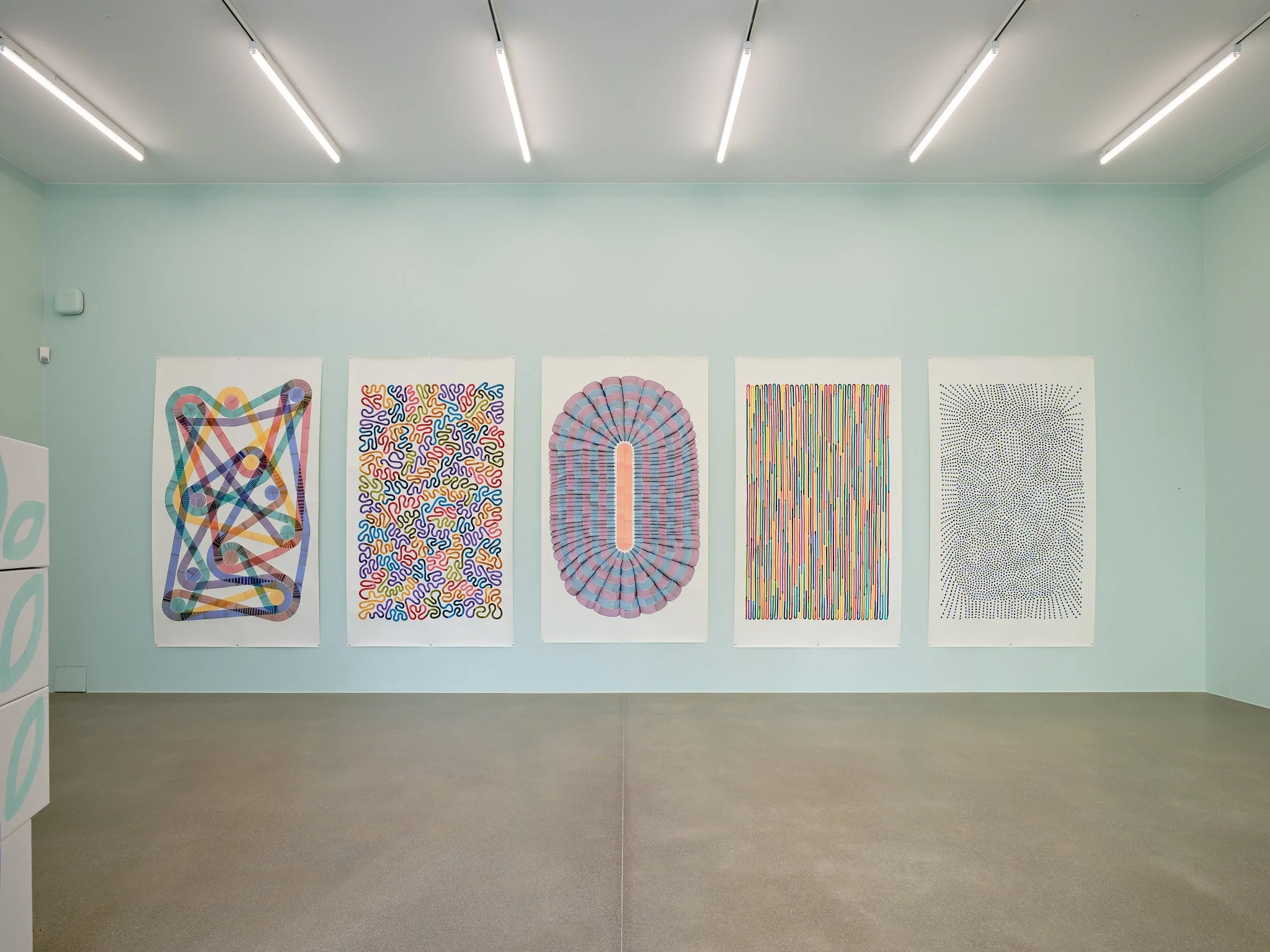
Tobias Gutmann, drawings on paper. Installation view, Aargauer Kunsthaus, Aarau, 2026.
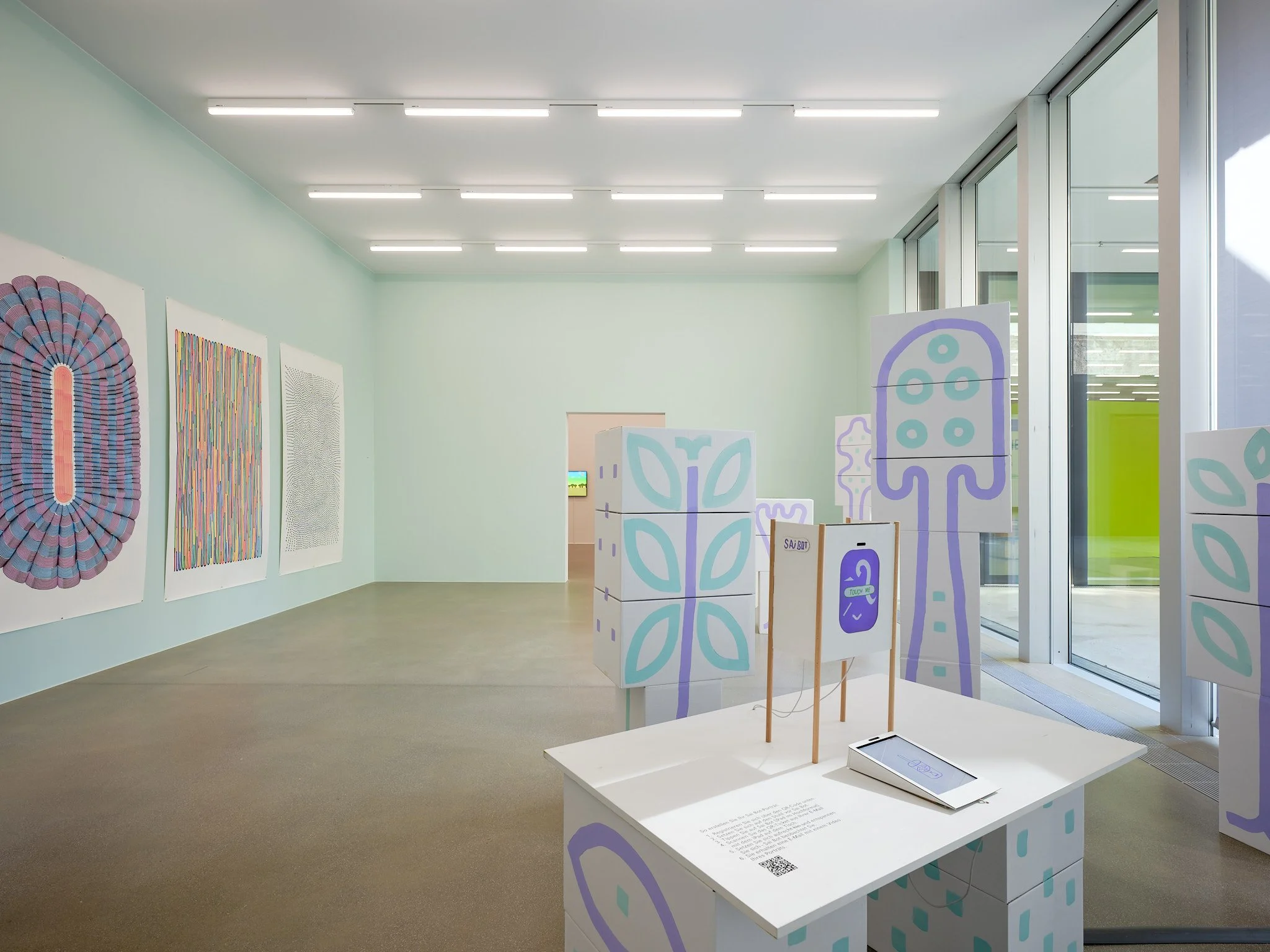
Sai Bot and cardboard figures by Tobias Gutmann. Installation view, «Künstliche Kreativität», Aargauer Kunsthaus, Aarau, 2026.
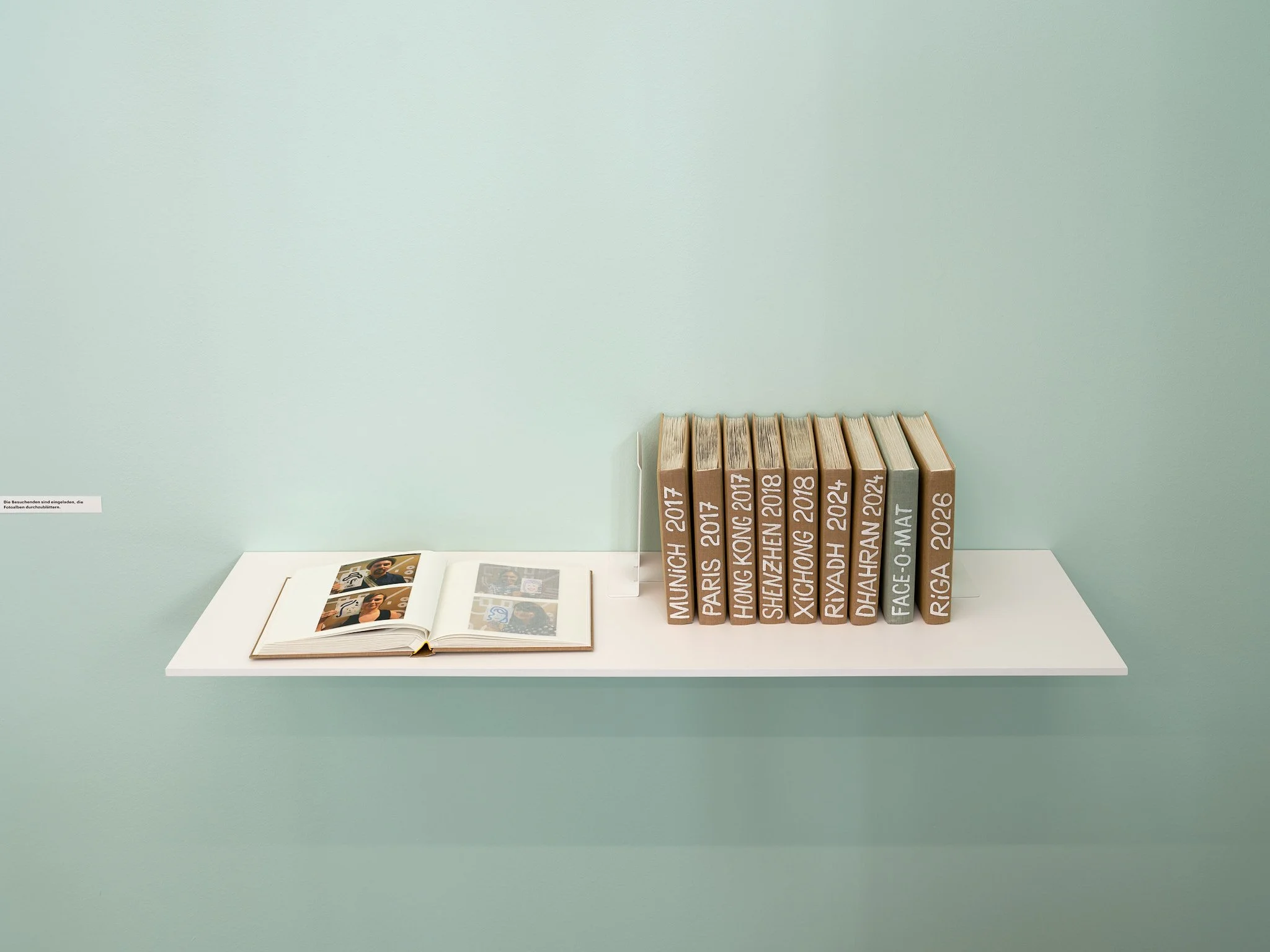
Face-o-mat albums, 2017–2026, one for each city. Visitors are invited to leaf through them. Aargauer Kunsthaus, Aarau, 2026.